When a company decides to build a new office building, they don’t just buy a mountain of bricks, hire some laborers, and tell them to start stacking. They hire an architect. They map out the foundation, calculate the weight-bearing walls, and plan for plumbing, electricity, and future expansions. They know that a mistake in the blueprint today means a collapsing roof tomorrow.
Yet, when it comes to digital assets, many companies treat software like a pile of bricks. They rush to write code, install generic plugins, or patch together pre-made templates just to launch quickly.
A few years down the line, they hit a wall. The system slows down, adding a simple new feature takes months, and security vulnerabilities start to pop up.
This is the exact point where executives realize the business value of custom software architecture. At Bunnychain.ai, we know that architecture isn’t just about code—it is the strategic blueprint that determines whether your digital business can scale up or if it will crumble under its own weight.
What is Software Architecture?
Let’s skip the confusing computer science textbooks. Software architecture is simply the high-level structure of a software system. It defines how different parts of your system—like your database, your user interface, and your third-party tools—talk to one another, how they store data, and how they handle user traffic.
Custom architecture means that this structure is designed specifically around your unique business goals, workflows, and future roadmaps. It ensures that your technology serves your business, rather than your business being limited by your technology.
Pillar 1: Eliminating the Silent Killer Called “Technical Debt”
In finance, if you borrow money, you have to pay it back with interest. The same thing happens in software. When you build software quickly using cheap templates or messy code, you are borrowing time. This is called “Technical Debt.”
Every time your development team has to work around a poorly designed system to add a new feature, they are paying the “interest” on that debt. Eventually, the interest becomes so high that your team spends 80% of their time just fixing bugs instead of building new revenue-generating features.
This is where the business value of custom software architecture becomes crystal clear. By investing in a clean, custom blueprint from day one, you avoid technical debt. Your system remains organized, clean, and flexible, allowing your team to deploy updates quickly and keep your business ahead of the competition.
Pillar 2: Scalability and Performance Under Pressure
Imagine your marketing team runs a massively successful campaign, and your website traffic suddenly spikes by 1,000% in a single hour.
If your software architecture is rigid or poorly planned, your server will crash. Your customers will see error messages, your brand reputation will take a hit, and you will lose thousands of dollars in real-time sales.
Custom software architecture is built with “scalability” in mind. Instead of a single, heavy system that crashes under pressure, custom systems often use modular structures. This means that if your checkout system is experiencing high traffic, the architecture automatically allocates more digital power to just that specific section, keeping the entire platform running smoothly without driving up your hosting costs.
Pillar 3: Security, Compliance, and Risk Management
In 2026, data breaches are catastrophic. A single leak of customer data can result in massive legal fines, lost trust, and irreversible damage to your brand.
Generic, off-the-shelf software structures are a favorite target for hackers. Because thousands of websites use the exact same templates, a hacker only needs to find one flaw to break into thousands of businesses.
Custom architecture allows our developers to build security directly into the foundation of your system. We isolate sensitive user data, encrypt communication channels, and design compliance protocols that match your specific industry standards. Security isn’t treated as a layer you add at the end; it is built into the very bones of the software.
Comparing Generic Templates vs. Custom Architecture
To truly understand how this investment impacts your business, let’s look at the lifecycle differences between a generic software setup and a custom-architected system.
With a Generic Template Setup, the “Initial Launch” is incredibly fast and cheap, which feels like a win. However, the “Long-Term Costs” quickly skyrocket as you pay for constant bug fixes and expensive plugin workarounds. The “System Flexibility” is extremely low, meaning you cannot easily change your features as your business evolves. Over time, the “Operational Efficiency” drops, as your staff struggles with slow, clunky tools that don’t match their actual daily workflows.
With a Custom Software Architecture (The Bunnychain Way), the “Initial Launch” requires a larger investment of time and thought. But the “Long-Term Costs” drop to almost zero because the system is stable and clean. The “System Flexibility” is infinite, allowing you to add new features or pivot your business model smoothly. Ultimately, the “Operational Efficiency” is maximized, giving your team a fast, reliable tool tailored exactly to how your business wins.
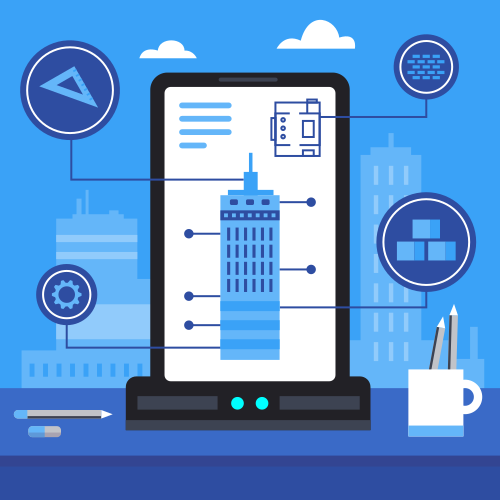
The Bunnychain Integrated Approach to Clean Systems
A beautiful architecture means nothing if the user experience feels clumsy, and a gorgeous design means nothing if the system crashes. True digital success requires a smooth collaboration across three key areas:
-
Our Architects and Developers map out the technical data structures, ensuring the backend is fast, secure, and ready to scale.
-
Our Designers work hand-in-hand with the technical blueprint to ensure that the complex code translates into an effortless, beautiful user interface.
-
Our Marketers leverage this robust system, knowing they can launch aggressive traffic campaigns without ever worrying about site slowdowns or technical glitches.
At Bunnychain.ai, we don’t build software in isolated silos. We unify design, code, and strategy to build digital assets that double as long-term financial assets.
Secure Your Business Foundation Today
The technology choices you make this year will dictate your operational costs for the next five years. Relying on short-term technical shortcuts might save a bit of budget this month, but it creates a heavy anchor that slows down your company’s growth in the future.
When you embrace the business value of custom software architecture, you are building an agile, resilient, and highly valuable asset. You are ensuring that when your business is ready to grow, your technology is ready to lead the way.
Summary: Your Technical Blueprint Checklist
-
Assess your speed: Is technical debt currently slowing down your development team?
-
Plan for growth: Can your current software handle a sudden fivefold increase in users?
-
Audit your security: Is your system built on generic code that leaves you vulnerable to attacks?
-
Focus on workflow: Does your software match your unique business processes, or are you forcing your team to work around the software?
-
Invest in the blueprint: Take the time to architect your system properly before writing the first line of code.
Let’s Build a Architecture That Scales
At Bunnychain.ai, we are ready to help you analyze your current systems, clean up costly technical debt, and engineer a custom digital architecture built specifically for your long-term success.