Getting someone to visit your online store doesn’t mean they’re ready to buy.
A customer might click an advertisement, look at a product, compare prices, read reviews, and then leave without purchasing.
This is where an ecommerce sales funnel can make a major difference.
Instead of sending every visitor to a general homepage and hoping they find their way to checkout, a sales funnel creates a more focused journey.
The customer sees the right message, learns about the product, receives relevant offers, and is guided toward completing the purchase.
A good funnel doesn’t pressure people into buying.
It simply makes the buying decision easier.
In this guide, we’ll explain what an ecommerce sales funnel is, how it works, what pages you need, and how to optimize each stage for better conversions.
What Is an Ecommerce Sales Funnel?
An ecommerce sales funnel is a structured customer journey designed to turn visitors into buyers.
A traditional ecommerce journey might look like:
Ad → Homepage → Category → Product → Cart → Checkout
A focused sales funnel might look like:
Ad → Landing Page → Product Offer → Checkout → Order Bump → Upsell → Thank You
The second journey gives the customer fewer distractions and a clearer path.
The exact structure depends on the product, audience, traffic source, and business model.
Why Ecommerce Funnels Matter
A good ecommerce funnel can help you:
- Improve conversion rates
- Reduce distractions
- Increase average order value
- Recover more potential sales
- Improve customer experience
- Make paid traffic more profitable
- Test different offers
This becomes especially valuable when you’re paying for traffic.
If you spend $10,000 on advertising, increasing your conversion rate can have a much bigger impact than simply sending more visitors to the same underperforming page.
The Main Stages of an Ecommerce Funnel
Most ecommerce funnels can be divided into several stages.
1. Awareness
The customer discovers your brand through:
- Social media
- Paid advertising
- Influencers
- YouTube
- Organic content
At this stage, the customer may not know much about your product.
Your goal is to get their attention and give them a reason to continue.
2. Interest
Now the customer wants to understand the offer.
They may ask:
- What is this product?
- How does it work?
- Is it right for me?
- Why is it better than alternatives?
Your landing page and product content should answer these questions clearly.
3. Consideration
The customer is interested but still has doubts.
They may compare:
- Price
- Features
- Reviews
- Quality
- Shipping
- Returns
- Competitors
This is where trust and clear information become extremely important.
4. Purchase
The customer is ready to buy.
Your checkout should make completing the purchase as simple as possible.
5. Post-Purchase
The funnel shouldn’t end after payment.
You can use the post-purchase stage to:
- Confirm the order
- Provide helpful information
- Offer complementary products
- Encourage repeat purchases
- Build customer loyalty
A strong post-purchase experience can turn a one-time buyer into a returning customer.
Step 1: Choose One Clear Goal
Before building your funnel, decide what you want it to accomplish.
For example:
Sell one product
or
Generate leads for a high-ticket product
or
Promote a product bundle
or
Increase subscriptions
Trying to accomplish everything in one funnel usually creates confusion.
One funnel should have one primary goal.
Step 2: Understand Your Customer
Before writing copy or designing pages, understand who you’re selling to.
Ask:
- What problem are they trying to solve?
- What are they worried about?
- What alternatives have they considered?
- What would make them trust your brand?
- Why might they hesitate to purchase?
The answers should influence the entire funnel.
Good funnels are built around customer needs—not simply around products.
Step 3: Create a Strong Landing Page
The landing page is often the first major step after an advertisement.
Its job is to continue the conversation that started in the ad.
A strong landing page usually includes:
- Clear headline
- Product benefit
- Supporting explanation
- Product visuals
- Social proof
- Key benefits
- CTA
The visitor should understand the offer without having to search through the page.
Step 4: Focus on Benefits, Not Just Features
Features explain what a product has.
Benefits explain why the customer should care.
For example:
Feature:
“5000 mAh battery.”
Benefit:
“Stay powered throughout the day without constantly searching for a charger.”
Benefits make products easier to understand and more relevant.
Step 5: Add Social Proof
Customers naturally look for evidence before purchasing.
Use:
- Reviews
- Testimonials
- Customer photos
- Video testimonials
- Ratings
- Case studies
Don’t hide your strongest proof at the bottom of the page.
Place relevant social proof near important purchasing decisions.
Step 6: Create a Clear Offer
Your funnel needs more than a product.
It needs a compelling offer.
An offer might include:
- Main product
- Product bundle
- Discount
- Free shipping
- Bonus
- Guarantee
- Limited-time promotion
The goal is to communicate the total value clearly.
Step 7: Build a Simple Checkout
The checkout should remove friction—not create it.
Keep it:
- Clear
- Fast
- Mobile-friendly
- Secure
- Easy to understand
Make sure customers can easily see:
- Product
- Quantity
- Price
- Shipping
- Taxes
- Total
Unexpected information at checkout can cause customers to abandon their purchase.
Step 8: Add an Order Bump
An order bump is a small additional offer shown during checkout.
For example:
A customer buys a skincare product.
The checkout could offer:
“Add our travel-size cleanser for $9.”
The offer should be:
- Relevant
- Simple
- Affordable
- Easy to accept
The objective isn’t to overwhelm customers with more products.
It’s to provide something genuinely useful.
Step 9: Use One-Click Upsells
After a customer purchases, you can present a relevant additional offer.
For example:
Main purchase: Running shoes
Upsell: Premium running socks
Second upsell: Shoe care kit
Because the customer has already completed the initial purchase, the additional offer can increase the value of the transaction.
This is one reason funnels can be particularly effective for increasing Average Order Value.
Step 10: Create a Thank-You Page
Don’t waste the opportunity after checkout.
A thank-you page can:
- Confirm the order
- Explain what happens next
- Provide support information
- Introduce related products
- Encourage social sharing
- Invite customers to join your community
The customer’s relationship with your brand doesn’t end when the payment is processed.
When Should You Use an Ecommerce Funnel?
Funnels work particularly well for:
- Paid advertising campaigns
- Product launches
- Single-product businesses
- Product bundles
- Flash promotions
- Subscription offers
- Influencer campaigns
- High-margin products
If you’re sending paid traffic to a specific product, a dedicated funnel can make it easier to control the customer journey.
Funnelish for Ecommerce Funnels
Platforms such as Funnelish are designed specifically around ecommerce funnel experiences.
They can be useful for businesses that want to build journeys involving:
- Landing pages
- Checkout experiences
- Order bumps
- Upsells
- Downsells
- Post-purchase offers
How to Optimize Your Ecommerce Funnel
Launching a funnel isn’t the finish line.
You should continuously analyze performance and improve the weakest stages.
For example:
High landing-page traffic + low product engagement
The problem may be your messaging or offer.
Strong product engagement + low checkout starts
The product page or CTA may need improvement.
High checkout starts + low purchases
Look closely at payment, shipping, trust, and checkout friction.
Strong purchases + low AOV
Consider bundles, order bumps, and upsells.
This approach helps you focus on the actual problem rather than redesigning everything.
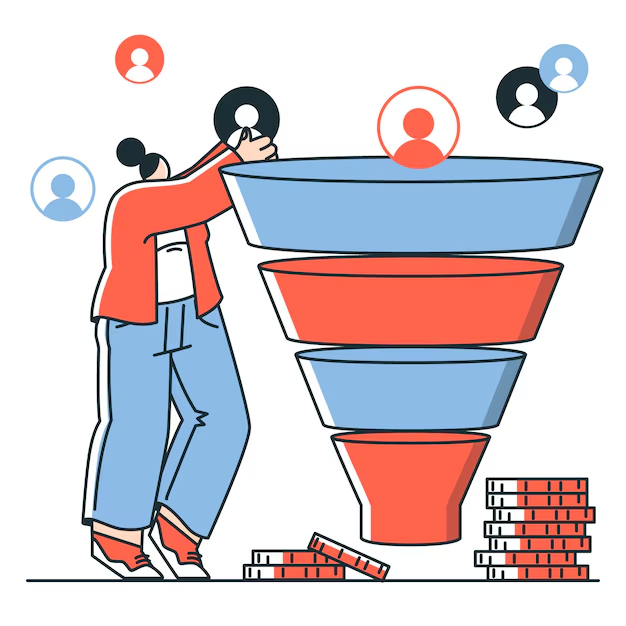
Important Ecommerce Funnel Metrics
Track metrics such as:
Landing Page Conversion Rate
Measures how many visitors take the desired next action.
Add-to-Cart Rate
Shows how effectively your product offer encourages customers to begin purchasing.
Checkout Conversion Rate
Measures how many checkout visitors complete their purchase.
Average Order Value
Shows how much customers spend per order.
Revenue Per Visitor
Helps determine how effectively your funnel turns traffic into revenue.
Upsell Take Rate
Shows how many customers accept your additional offers.
These metrics help you understand where your funnel is performing well and where it needs improvement.
Common Ecommerce Funnel Mistakes
Sending Everyone to the Homepage
A homepage is designed for exploration. A funnel usually has a more specific objective.
Too Much Information
More content isn’t automatically better.
Give customers the information they need to make a decision, but keep the journey focused.
Weak Offer
Even a beautiful funnel won’t perform well if the offer doesn’t provide enough value.
Too Many Upsells
Customers don’t want to feel like every page is another sales pitch.
Keep additional offers relevant.
Ignoring Mobile Users
Always test the complete funnel on mobile devices.
Not Testing
Your first version isn’t necessarily your best version.
Use real data to improve it.
How BunnyChain Builds Ecommerce Funnels
At BunnyChain, we combine ecommerce development, conversion strategy, and funnel development to create customer journeys designed around business goals.
Our services include:
- Ecommerce Website Development
- Shopify Development
- Funnel Development
- Funnelish Development
- Conversion Rate Optimization
- Technical SEO
- Website Performance Optimization
We can help you connect your ecommerce store, landing pages, checkout experience, and post-purchase journey into one clear customer experience.
Final Thoughts
A high-converting ecommerce funnel isn’t about adding more pages or aggressive sales tactics.
It’s about making the buying journey easier.
The right message gets the customer’s attention.
The landing page explains the value.
The product page builds confidence.
The checkout removes friction.
The upsell increases order value.
And the post-purchase experience builds the relationship.
When every stage works together, your funnel can turn more of your existing traffic into customers and make your marketing investment work harder.
Ready to Build a High-Converting Ecommerce Funnel?
If you’re driving traffic to your store but aren’t getting the sales you expect, the problem may be the customer journey—not the amount of traffic.
BunnyChain can help you design, develop, and optimize an ecommerce funnel built around your products, customers, and growth goals.
Explore Our Services
- Funnel Development
- Funnelish Development
- Shopify Development
- Ecommerce Website Development
- Conversion Rate Optimization
- Technical SEO
Build a Better Customer Journey
Book a free consultation with BunnyChain and discover how a custom ecommerce funnel can help you increase conversions, improve Average Order Value, and grow your online business.